Milk Teeth Decay Treatment in Chennai: Fillings, Pulpectomy and Crowns
Your child points to a back tooth and says it hurts. Or you spot a brown or black patch on a milk tooth and wonder whether milk teeth decay treatment is even needed, since the tooth will fall out anyway.
Milk teeth decay treatment depends on how deep the decay has gone. An early white spot can often be managed with fluoride and better home care. A cavity needs a filling.
Decay that has reached the nerve usually needs pulp treatment, either a pulpotomy or a pulpectomy (often called a root canal for milk teeth), followed by a crown. A tooth is removed only when it cannot be restored.
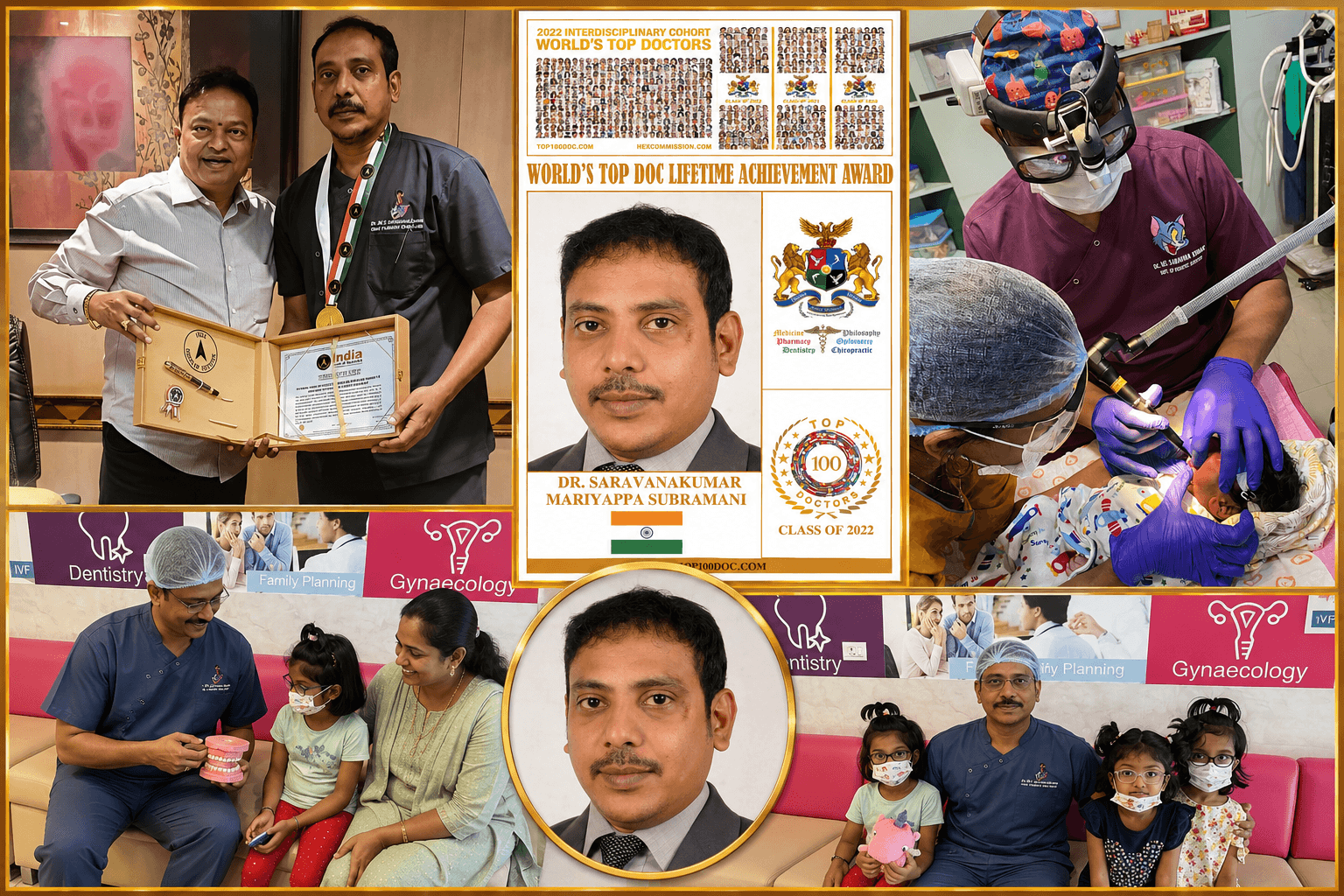
This guide explains each option the way Dr. Saravanakumar Mariyappa explains it to parents at Kannmani Dental Home in CIT Nagar, Chennai. He holds an MDS in Pediatric Dentistry and has treated children for 19 years. You will also find the clinic’s actual fees, so you know what to expect before you visit.
Why do milk teeth decay so quickly?
Milk teeth have thinner enamel than permanent teeth, so decay can travel from a small spot to the nerve faster than most parents expect. Decay starts when bacteria in the mouth feed on sugar and produce acid. That acid slowly dissolves the enamel. The more often sugar reaches the teeth, the more time the acid has to work.
Common triggers include:
- Night-time feeds of milk, formula or juice, especially when a child falls asleep while feeding.
- Sipping sweet drinks or snacking on biscuits and sweets through the day.
- Brushing that misses the back teeth, or skipping brushing before bed.
Prevention is where Dr. Saravanakumar’s own philosophy begins. He focuses on a baby’s first 1,000 days, which he describes as the “foundation for 100 years health and wealth.” Habits formed in that window shape how well a child’s teeth do for years afterwards.
What are the signs of tooth decay in milk teeth?
The earliest sign is a chalky white spot or line near the gum. Later, the spot turns yellow, brown or black, and a hole may form. Many young children never say a tooth hurts. Instead, they change how they eat.
Watch for these signs:
- White, brown or black patches on the teeth, or a visible hole.
- Pain or sensitivity with sweets, cold drinks or chewing.
- Chewing on one side, refusing food, or waking at night with pain.
- Food packing between the back teeth.
- Swollen gums, or a small pimple-like boil on the gum near a tooth.
- A mouth odour that does not go away with brushing.
Does decay in milk teeth need treatment if they fall out anyway?
Yes. Milk teeth hold space for the permanent teeth growing underneath, and the back milk teeth usually stay until a child is about 10 to 12 years old. They let your child chew properly and speak clearly. An untreated infection can also spread around the root and reach the permanent tooth developing below it.
How is tooth decay in milk teeth treated?
Treatment follows the depth of the decay. Early decay without a hole can sometimes be reversed, while a cavity is cleaned and filled. Decay that reaches the nerve needs pulp treatment and a crown. A tooth that is too broken down or too infected is removed.
Which one your child needs is decided after an examination and, where needed, an X-ray.
| How far the decay has gone | What you may notice | Usual treatment |
| Early, enamel only | Chalky white spots, no hole | Fluoride application, fewer sugary snacks, better brushing |
| A cavity | Brown or black spot, a hole, sensitivity | Filling |
| Decay has reached the nerve (pulp) | Pain, often at night, sometimes swelling | Pulpotomy or pulpectomy, followed by a crown |
| Tooth cannot be restored | Tooth severely broken down or infected | Extraction, with a space maintainer when needed |
What is a pulpectomy for a child?
A pulpectomy is a root canal treatment for a milk tooth. The dentist removes the infected nerve tissue, called the pulp, from the crown and the roots. The canals are then cleaned.
As the American Academy of Pediatric Dentistry (AAPD) describes, they are filled with a resorbable material that the body absorbs as the tooth gets ready to fall out. The tooth is then protected with a crown.
Dr. Saravanakumar chooses a pulpectomy when two things are true. The tooth can be restored, and it will stay in the mouth for as long as it is needed before the permanent tooth takes its place. If either is not the case, removing the tooth is usually the better choice.
The procedure follows these steps:
- The tooth and gum are numbed with a local anaesthetic.
- The decay is removed and the pulp chamber is opened.
- The infected pulp is cleaned out of the crown and the root canals.
- The canals are filled with a material that dissolves as the permanent tooth grows.
- The tooth is sealed and covered with a crown.
Pulpotomy vs pulpectomy: what is the difference?
A pulpotomy removes only the infected nerve tissue in the crown of the tooth and leaves the healthy tissue in the roots. A pulpectomy removes the nerve tissue from both the crown and the roots. Which one a tooth needs is a clinical decision, made after the dentist has examined the tooth.
At Kannmani Dental Home, the choice is made on examination. If the infection or damage is limited to the crown of the tooth and the roots are normal, Dr. Saravanakumar performs a pulpotomy. When the infection extends into the roots and the tooth can still be restored, a pulpectomy is the usual choice.
Is a pulpectomy the same as a root canal?
A pulpectomy is often described to parents as a root canal for milk teeth, and many parents search for it as “root canal for kids.” It differs from an adult root canal in one important way: the filling material.
A milk tooth’s canals are filled with a material that dissolves as the permanent tooth pushes through. That way the milk tooth can still loosen and fall out on its own.
Is a pulpectomy painful or safe for a young child?
A pulpectomy is a routine procedure in pediatric dentistry. It is done under local anaesthesia, so your child should not feel pain during treatment, though they may feel some pressure. Mild soreness for a day or two afterwards is common. Treatment also relieves the toothache that an infected nerve causes.
Age on its own is not a reason to avoid a pulpectomy. What matters is whether the tooth can be restored and how long it still needs to stay.
Sedation is not the first step. Dr. Saravanakumar first lets a child get comfortable with the clinic. After some familiarisation, many children settle with distraction, such as a TV screen, music or simple conversation. Others respond well to positive talk and reassurance.
If these approaches are not enough, he considers laughing gas (nitrous oxide) or mild sedation. He uses them when a child has high fear or anxiety, is restless and cannot sit still, needs extensive or complicated treatment, or has a strong gag reflex.
Crowns after a pulpectomy: stainless steel or zirconia?
After a pulpectomy, a milk tooth is weaker than before, so it is usually covered with a crown. The crown lets your child chew on that tooth until it falls out naturally. At Kannmani Dental Home, the choice of crown depends on where the tooth is.
| Tooth | Crowns used at the clinic | What parents should know |
| Front teeth | Aesthetic crowns, strip crowns, zirconia crowns | All are tooth-coloured, so the smile looks natural |
| Back teeth (molars) | Stainless steel crowns or zirconia crowns | Stainless steel is silver and strong; zirconia is white |
A strip crown is a tooth-coloured crown built directly on the tooth using a thin, clear mould. Stainless steel and zirconia crowns are both standard materials for milk teeth. On back teeth, many parents choose stainless steel because the tooth is not visible when the child smiles.
Dr. Saravanakumar places a crown after most pulpectomies. He may decide against one when the tooth is close to falling out and the permanent tooth is about to replace it. How much healthy tooth structure remains also shapes the decision.
When does a milk tooth need to be removed?
A milk tooth is removed when it cannot be restored or when the infection is too severe to treat. Removing the tooth is only half the decision. The next question is whether the gap needs a space maintainer, a small appliance that keeps the space open so the neighbouring teeth do not drift into it.
Dr. Saravanakumar decides this by looking at when the permanent tooth underneath is expected to come in:
- If it is likely to erupt within about six months, no space maintainer is needed.
- If it is still many years away and bone still covers it, he places a suitable space maintainer.
A case from our clinic: a five-year-old who stopped eating
A five-year-old boy was brought to the clinic with pain in his lower left back teeth. On examination, several of his teeth had decay. Two lower back teeth were severely decayed, with swelling around them. His mother said he had not been eating properly for one to two months and had lost weight.
Both teeth could be saved. Dr. Saravanakumar performed a pulpectomy on each of them and then covered each with a stainless steel crown.
He recovered well after treatment.
As this case shows, a change in eating can be the first visible sign of a painful tooth in a young child, before they can explain what hurts.
How much does milk teeth decay treatment cost in Chennai?
At Kannmani Dental Home, a consultation costs ₹500 to ₹1,000. A pulpectomy costs ₹3,500 and a stainless steel crown costs ₹2,000 per tooth. A tooth-coloured zirconia crown for a front tooth costs ₹6,000. Your final cost depends on how many teeth need treatment, which is decided after the examination.
| Treatment | Fee at Kannmani Dental Home |
| Consultation | ₹500 to ₹1,000 |
| Pulpectomy (per tooth) | ₹3,500 |
| Stainless steel crown (per tooth) | ₹2,000 |
| Zirconia crown, front tooth (per tooth) | ₹6,000 |
For example, a pulpectomy with a stainless steel crown on one back tooth comes to ₹5,500, plus the consultation. Fees for fillings, X-rays, extractions and space maintainers are explained at the consultation.
How can you prevent tooth decay in milk teeth?
Daily habits go a long way in preventing decay in milk teeth. They work best when they start with the very first tooth.
- Brush twice a day from the first tooth. The AAPD recommends a smear of fluoride toothpaste, about the size of a grain of rice, until age three, and a pea-sized amount from three to six.
- Do not put your child to sleep with a bottle of milk, formula or juice. After the night-time brush, offer only water.
- Keep sweet snacks and drinks to mealtimes rather than through the day.
- Brush for your child, or check their brushing, until they can do it well on their own.
- Book the first dental visit within six months of the first tooth appearing, and by the first birthday at the latest, as the AAPD advises.
An early visit is also the easiest one for a child. There is usually no treatment, only a gentle look and advice for parents, so the dental chair becomes familiar before anything ever hurts.
When should you see a pediatric dentist urgently?
Book an appointment promptly if your child has any of the following. An infection in a milk tooth can spread, and early treatment keeps it simpler.
- Swelling of the gum, cheek or face.
- Fever along with tooth pain.
- A boil or pus on the gum near a tooth.
- Tooth pain that wakes your child at night.
- A knocked, cracked or broken tooth after a fall.
Milk teeth decay treatment at Kannmani Dental Home, CIT Nagar, Chennai
Kannmani Dental Home is a pediatric dental clinic at 3/63, 5th Main Road, CIT Nagar, Chennai 600035, close to T Nagar, Nandanam and Saidapet. Fees for the main treatments are published above, so you know the cost before you visit.
If you have noticed spots, pain or a change in how your child eats, book a consultation with Dr. Saravanakumar to have the teeth checked and talk through the options. Call 91763 16667
About Dr. Saravanakumar Mariyappa
Dr. Saravanakumar Mariyappa holds an MDS in Pediatric Dentistry and has 19 years of experience treating children. He holds an American Board International Fellowship and has received a national award from the India Book of Records.
His approach is baby friendly and starts with prevention, guided by the first 1,000 days. When a tooth does need treatment, he explains which option fits each tooth and why, and he helps a child settle before any sedation is considered. Beyond decay treatment, he leads the clinic’s laser tongue-tie release service for babies and children.
Frequently asked questions
Can a decayed baby tooth be saved?
Often, yes. If enough of the tooth remains and it still has time before it falls out, a decayed baby tooth can be saved with a filling. If the decay has reached the nerve, it can be saved with a pulpectomy and a crown. A tooth that is too broken down or too infected is removed instead.
Is pulpectomy safe for a 3 year old?
Yes, when it is done by a dentist trained in treating children. A three-year-old’s back milk teeth have many years left before they fall out, so saving them is often worthwhile. The tooth is numbed first. For an anxious child, distraction and reassurance come first, and laughing gas or mild sedation is used only when needed.
Can a 2 year old get a tooth filling?
Yes. Cavities can form as soon as teeth appear, and toddlers can have them treated. The approach is adapted to the child’s age and comfort, and small cavities need only a short visit. When a toddler is very anxious or several teeth need work, the dentist may suggest laughing gas or mild sedation so treatment can be completed safely.
Is baby bottle tooth decay reversible?
Only at its earliest stage, when it shows as chalky white spots and no hole has formed yet. Fluoride, fewer sugary feeds and regular brushing can help the enamel recover at that point. Once a spot turns brown or black and a cavity forms, the decay cannot heal on its own and needs treatment.
Is it normal for a 3-year-old to have cavities?
Cavities at three are not unusual, especially with night-time bottle feeds or frequent sweets. That does not make them harmless. A cavity in a milk tooth keeps growing if it is left alone. A check-up can catch decay while it is still a white spot, when it is easiest to manage.