Teething in Babies and Other First-Teeth Worries: 4 Things Chennai Parents Bring Us, and What We Tell Them
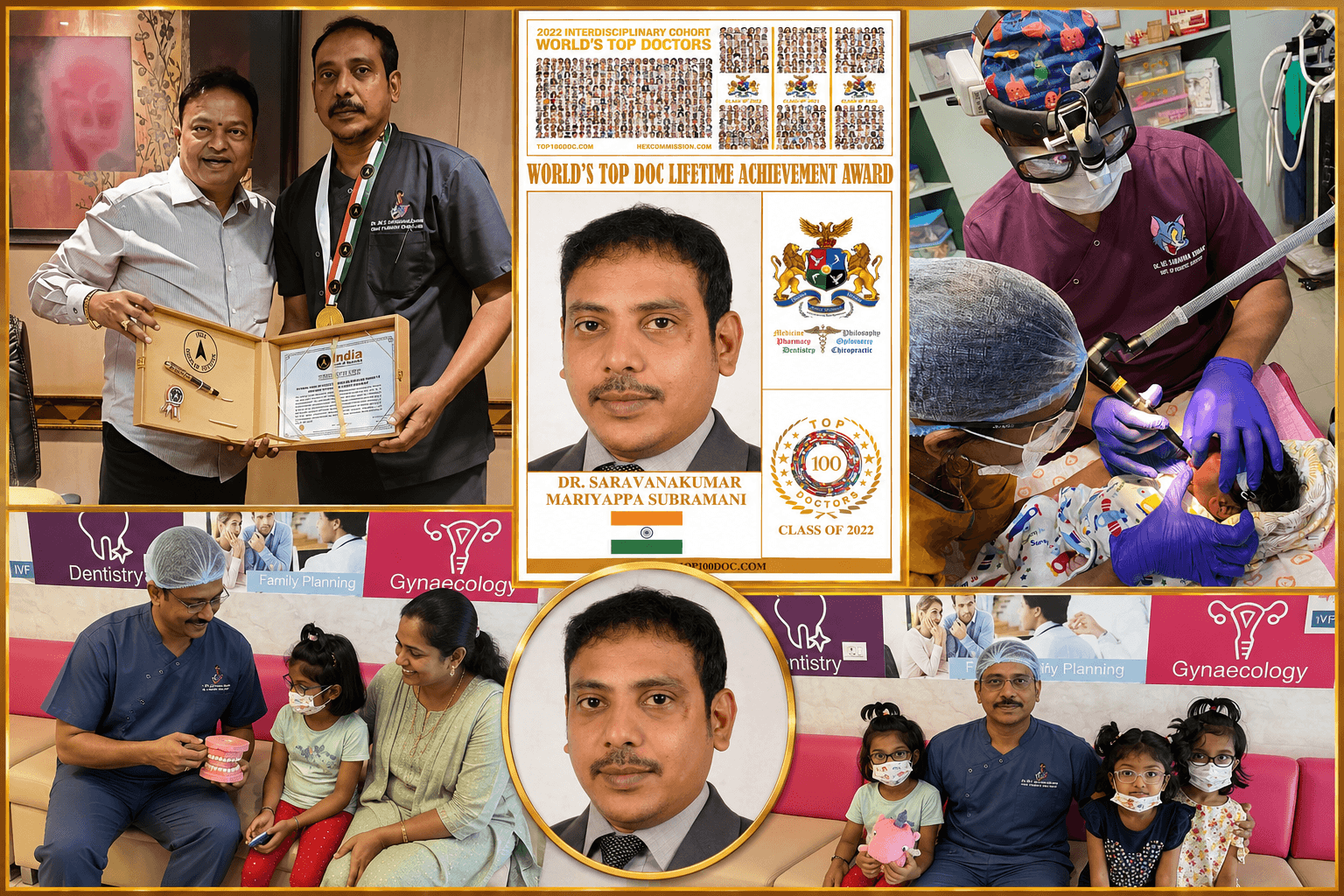
Medically reviewed by Prof. Dr. M. S. Saravanakumar, MDS (Pediatric Dentistry), Kannmani Dental Home, CIT Nagar, Chennai · Published 07/11/2026
A teething baby runs a temperature, and everyone blames the tooth. A one-year-old still has no teeth, and the parents are worried. A mother brings her newborn in and asks us to remove “the tooth” that is coming, and it turns out to be a tiny white bump on the gum. A baby is born with a tooth, and the family wonders whether it is a bad sign.
These are four worries families bring to Prof. Dr. M. S. Saravanakumar, paediatric dentist at Kannmani Dental Home, CIT Nagar. Below is what he checks in each case, what he tells parents, and what published research says. Teething in babies comes first, because it is the one every family meets and the one parents most often manage at home.
Teething in babies: the short answer
Teething is the normal process of milk teeth coming through the gums. Some babies pass this stage without any trouble. Others drool, rub their gums and become fussy for a few days around each tooth.
Teething can make a baby slightly warm, but it does not cause a real fever of 38°C or more, and a baby with fever, loose motions that continue, or vomiting should see the paediatrician.
Worry 1: “Teething gave my baby fever and loose motion”
Prof. Dr. Saravanakumar’s view is that teething in babies is a normal stage, and babies go through it differently. Some have no trouble at all. In his experience, some may have looser stools, spit up more, or feel a little warm while a tooth comes through.
A large review of studies found the most common signs to be sore, irritated gums, fussiness and drooling. Teething was linked with a small rise in body temperature, but not one high enough to count as a fever. Diarrhoea and vomiting were not strongly linked with teething.
When it is not just teething
See your baby’s doctor if your baby has:
- a temperature of 38°C or more
- loose motions that keep going, or any vomiting
- a baby who seems very upset, sleepy or clearly unwell
- any temperature of 38°C or more in a baby under 3 months old: this needs prompt medical assessment, so do not wait
Babies start teething at the same age they start catching common infections, so the two often arrive together. It is safer to check for illness than to assume it is the tooth.
The bluish bubble over a coming tooth
Sometimes a soft, bluish or purple swelling forms on the gum just over a tooth that is about to come through. This is an eruption cyst. Most settle on their own once the tooth breaks through.
Prof. Dr. Saravanakumar asks parents to bring the baby in if they see one. When a cyst is large or bothering the baby, he may open it with a laser so the tooth can come through.
What helps a teething baby, and what to avoid
At the first dental visit, Prof. Dr. Saravanakumar prepares parents for teething before it starts, so they know it may come and need not worry. For discomfort, he says a paracetamol syrup suitable for the baby’s age is usually enough.
Give it exactly as the label or your baby’s doctor directs. If your baby is under 3 months old, ask your baby’s doctor before giving any medicine, including paracetamol.
Other simple, safe ways to soothe sore gums:
- let the baby chew on a firm rubber teething ring that has been chilled in the fridge, not frozen hard
- gently rub the gums with a clean finger
- give plenty of cuddles and attention
Things to avoid:
- Honey on the gums, the teether or a dummy. Honey should not be given to babies under one year, because of the risk of infant botulism, a rare but serious illness.
- Numbing gels containing benzocaine. The American Academy of Pediatrics does not recommend them for infants.
- Adult mouth-ulcer gels. Some contain salicylate, a chemical related to aspirin, and are not for children under 16.
- Aspirin, in any form, for a baby or child.
- Teething necklaces or bead bracelets. They do not relieve pain, and babies have choked on the beads or been strangled by the string.
Before using any teething syrup or gel, read what it contains and ask your baby’s doctor if you are unsure.
Worry 2: “My baby is one year old and still has no teeth”
This is a question many parents bring him, and it is one where his advice has changed with what he sees. Textbooks have long said the first tooth comes at 6 to 8 months. In his practice today, many babies get their first tooth at 12, 13 or 14 months, and they are healthy. Even parents who are doctors ask him about it.
Research agrees that the timing varies widely. The lower front teeth usually come first, often between 6 and 10 months, but a delay of up to a year may mean little in an otherwise healthy child. Babies born early may also get their teeth later.
His approach is to reassure parents that the tooth will come. If it is slow, he may take an X-ray to show them that the teeth are there under the gum, waiting. He also sees babies whose upper front tooth comes before the lower one. That is a normal variation too.
A first tooth that still has not appeared by around 18 months is generally treated as worth looking into, to rule out a medical cause. If your baby has passed their first birthday with no teeth, a dental check gives you an answer either way.
Worry 3: “A white tooth is coming. Can you remove it?”
Many parents come in having seen something small and white on their newborn’s gum or the roof of the mouth. They believe a tooth is coming, and some ask him to remove it. In most of these babies there is no tooth at all.
These little white or yellowish bumps are newborn cysts, tiny pockets of trapped tissue left over from the way the mouth formed before birth. They have different names depending on where they sit:
- Epstein pearls appear along the middle of the roof of the mouth. They are very common in newborns.
- Bohn’s nodules appear on the gums, and are the ones most often mistaken for teeth.
Both are harmless and usually clear up on their own within the first few months, without any treatment. That is what Prof. Dr. Saravanakumar tells parents: the bumps will go by themselves as the baby grows. He asks them to come back if a bump keeps growing, or if it makes feeding or breathing difficult.
Worry 4: “My baby was born with a tooth. Is it a bad sign?”
Some families feel that a baby born with a tooth brings bad fortune, or that it is a sign of something evil. Prof. Dr. Saravanakumar’s answer is direct: it is not connected with anything like that. “This is not a bad sign. This is not an evil,” he tells parents. It is a known dental condition, and it is rare: published reviews put it at about one in every 2,000 to 3,500 births.
Why does it happen?
He explains it simply. The tooth bud, the tiny tooth forming inside the jaw, is sitting higher than usual, so the tooth comes through early. Around 9 in 10 of these teeth are the baby’s own milk teeth that would normally have come at 6 to 8 months, arriving months ahead of time. A small number are extra teeth.
Dentists name these teeth by when they appear:
- Natal teeth are present at birth.
- Neonatal teeth come through in the first month.
- Early infancy teeth come through between one and about three months.
Natal teeth are about three times as common as neonatal teeth. They usually appear in the lower front of the mouth, and they are often small and loose, because the root has not formed fully yet.
When does he leave the tooth, and when does he remove it?
Many of these teeth can be left alone. Prof. Dr. Saravanakumar removes one when it causes a problem:
- it is very loose and shaking, and there is a worry it could come out and be swallowed or breathed in
- it makes breastfeeding difficult for the baby
- it injures the mother’s nipple during feeds
- it rubs and injures the underside of the baby’s tongue, causing an ulcer known as Riga-Fede disease
Before removing a tooth from a newborn, he checks whether the baby has had the vitamin K injection given at birth. A newborn’s blood does not clot well in the first days, and vitamin K protects against bleeding. Published case reports advise either waiting until the baby is about 10 days old or giving vitamin K first, after the paediatrician is consulted. The tooth is then removed gently under local anaesthesia. He stresses that this is a procedure for a paediatric dentist, done with great care.
A pattern worth knowing: there can be more than one
In one baby he saw, a sharp tooth present at birth was cutting the baby’s tongue and making feeding difficult, so it was removed. Some weeks later the mother came back, sure that the tooth had come back. It had not. A second tooth had come through. Teeth can arrive one after another in the first one to three months, so a family who has seen one early tooth should keep watching, and come back if another appears.
When should your baby first see a dentist?
As soon as the first tooth comes through, and no later than the first birthday. This is the recommendation of the American Academy of Pediatric Dentistry, and it is what Prof. Dr. Saravanakumar advises. The first visit is short. It is a chance to check the mouth, prepare parents for teething, and start cleaning the new teeth properly, before decay has a chance to begin.
This early start is the heart of his approach. He believes a child’s first 1,000 days are the foundation for 100 years of health and wealth. Our guide to tooth decay in milk teeth explains what happens when decay is missed. If your newborn also struggles to latch, our guides to tongue tie in babies and lip tie in babies cover what to look for.
Frequently asked questions
How many days does teething fever last?
A baby may feel slightly warm for a few days around the time a tooth breaks through, and this settles once the tooth is through. A temperature that reaches 38°C or stays raised is not teething; see the warning signs under Worry 1.
Do natal teeth fall out on their own?
Some are firm and stay, and many of these are the baby’s normal milk teeth. Others are very loose because their root has not formed. The worry with a very loose tooth is that it could come out during a feed and be swallowed or breathed in, which is why a dentist may advise removing it. Have any tooth present at birth checked by a paediatric dentist.
Are natal teeth linked to any syndrome?
A few rare syndromes are associated with natal teeth, but most babies born with a tooth are otherwise healthy. Your paediatrician and dentist will look at your baby as a whole and tell you whether any further check is needed.
Is a baby born with teeth lucky or unlucky?
Neither. It is a known dental condition in which the tooth forms higher in the jaw and comes through early. What matters is whether the tooth is loose, whether it hurts the baby’s tongue, and whether feeding is comfortable for mother and baby.
குழந்தைக்கு பல் முளைக்கும்போது காய்ச்சல் வருமா? (Does teething cause fever?)
பல் முளைக்கும்போது குழந்தை எரிச்சலாக இருக்கலாம், எச்சில் அதிகமாக வழியலாம், உடல் சற்று சூடாக இருக்கலாம். ஆனால் 38°C அல்லது அதற்கு மேல் காய்ச்சல், தொடர்ந்த வயிற்றுப்போக்கு அல்லது வாந்தி இருந்தால் அது பல்லால் ஏற்பட்டது அல்ல. குழந்தை மருத்துவரை அணுகுங்கள்.
In English: a teething baby may be fussy, drool more and feel slightly warm, but a fever of 38°C or more, continuing loose motions or vomiting are not caused by teething, so see the paediatrician.
Babies’ dental care at Kannmani Dental Home, CIT Nagar, Chennai
Kannmani Dental Home is a dental clinic in CIT Nagar, Chennai, focused mainly on children’s dentistry and led by Prof. Dr. M. S. Saravanakumar, MDS (Pediatric Dentistry), who has 19 years of experience in paediatric dentistry.
If your baby was born with a tooth, has bumps on the gums you are unsure about, or has passed the first birthday without a tooth, book a consultation to have it checked. The consultation fee is ₹500 to ₹1,000.
Kannmani Dental Home
3/63, 5th Main Road, CIT Nagar, Chennai 600035
Phone: 91763 16667
Open every day, 10 AM to 9 PM
Book a consultation
How this article was prepared: The medical content in this article is based on Prof. Dr. M. S. Saravanakumar’s own clinical experience and the reliable published sources cited below.
Sources
- Mhaske S, Yuwanati MB, Mhaske A, et al. Natal and neonatal teeth: an overview of the literature. ISRN Pediatrics 2013;2013:956269. PMC3759256
- Chieowwit N. Natal and neonatal teeth: dental management (review). Siriraj Medical Journal 2026;78(1). tci-thaijo.org
- Natal and neonatal teeth: a case series (vitamin K and timing of extraction). PMC6040504
- Kanumuri PK. Riga Fede disease. Journal of Neonatal Surgery 2017;6(1):20. PMC5224754
- Jain A, et al. Gum lesions in a newborn infant (Bohn’s nodules). Oman Medical Journal 2025;40(4):e787. org
- Atlas of lumps and bumps: Bohn nodules and Epstein pearls. Consultant360. com
- Delay in eruption of baby (primary) teeth. GPnotebook. com
- Delay in eruption of baby (primary) teeth. Primary Care Notebook. com
- When should you worry about a child’s baby teeth not erupting? Vinmec. com
- Massignan C, Cardoso M, Porporatti AL, et al. Signs and symptoms of primary tooth eruption: a meta-analysis. Pediatrics 2016;137(3):e20153501. Summary: com
- “It’s just teething…” Archives of Disease in Childhood 2016. org/10.1136/archdischild-2016-310972
- Apollo Pharmacy. Teething for infants: signs and safe remedies (fever under 3 months). in
- Signs of teething (citing NICE 2020). nct.org.uk
- info. Teething. patient.info
- Dental eruption cyst. Consultant360. com
- NHS North West London, Healthier Together. Teething (babies): pain relief from three months. westlondon.nhs.uk
- Teething tips (aspirin not for children under 16). nhs.uk
- American Academy of Pediatrics. Teething necklaces and beads: a caution for parents. org
- Oral salicylate gels: not for use in those younger than age 16 years. gov.uk
- Honey should not be fed to infants under one year of age. anses.fr
- American Academy of Pediatric Dentistry recommendation on the first dental visit. Decisions in Dentistry. com